



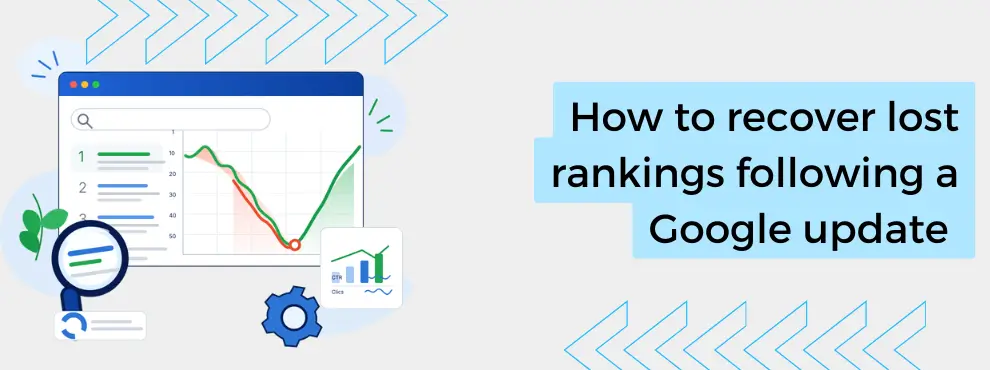
There are few things more frustrating in SEO than waking up one morning, opening Search Console and discovering that a significant share of your organic traffic has disappeared. Sometimes it happens gradually. Other times, the drop is immediate: keywords that had remained stable for years fall out of the Top 3, pages that used to convert stop receiving impressions, and historically strong URLs lose visibility with no apparent explanation. In most cases, there is a Google algorithm update behind that decline.
The problem is that many businesses react badly. They start changing titles compulsively, deleting content, modifying URLs, disavowing links without judgement or redesigning half the website in an attempt to “fix” something they do not yet understand. And that usually makes the situation worse.
After years analysing traffic drops after Core Updates, Helpful Content Updates and changes related to EEAT, there is a fairly clear conclusion: recovering positions is not about finding a hidden technical trick. It is about understanding which signals Google was rewarding before, which ones it is rewarding now, and why your site has partially stopped meeting those expectations.
In this guide, we are going to explain how to correctly diagnose a loss of rankings after a Google update and which steps genuinely have an impact when it comes to recovering organic visibility.
First things first: not every drop is Google’s fault
Before assuming that the algorithm has penalised you, you need to validate exactly what has happened.
Because many traffic losses that look like “an update” actually come from:
- poorly executed migrations,
- indexing problems,
- robots.txt errors,
- accidental noindex tags,
- performance drops,
- tracking issues,
- architecture changes,
- loss of internal links,
- canonical problems,
- or even Analytics errors.
This happens constantly.
That is why the first step is not “doing SEO”. The first step is correctly isolating the problem.
How to detect whether an update really affected you
The clearest signal is usually timing.
If traffic drops exactly during a confirmed Google update, there is probably a connection. But that is not enough. You need to analyse:
- which URLs dropped,
- which keywords lost positions,
- which type of content was affected,
- which competitors moved up,
- and whether the pattern is global or partial.
It is not the same to lose:
- the whole domain,
- only the blog,
- ecommerce categories,
- product pages,
- or informational searches.
Each scenario usually points to different problems.
The most common mistake: trying to recover quickly
Anxiety is usually the worst enemy after an update.
Many websites damage their visibility even further because they react impulsively:
- rewriting hundreds of pages,
- deleting content at scale,
- changing entire structures,
- or altering elements without a prior diagnosis.
Google needs time to reassess signals. And if you turn the site into an unstable environment, the algorithm receives even more uncertainty.
Recovery rarely happens in days. Sometimes it takes weeks. Or months.
What Google usually values after an update
Although Google never fully reveals how its algorithm works, there are very clear patterns in practically all major updates.
In recent years, Google’s systems have particularly prioritised:
- helpful content,
- real experience,
- topical authority,
- editorial quality,
- trust,
- user satisfaction,
- structural clarity,
- and EEAT signals.
The problem is that much traditional SEO content was designed solely to rank, not to genuinely help the user.
And that is where many websites start to lose ground.
Analyse which pages have lost visibility
Not all URLs should be treated in the same way.
A drop on a product page requires a different analysis from that of an informational guide or an ecommerce category.
That is why you need to detect patterns.
When informational content drops
The problem is usually related to:
- superficiality,
- generic content,
- excessive use of AI without review,
- lack of real experience,
- poor search intent alignment,
- or weak topical authority.
In many audits we find huge articles that answer the query worse than shorter but more useful pieces of content.
When ecommerce categories drop
The usual factors here include:
- thin content,
- poor architecture,
- weak internal linking,
- poor mobile experience,
- too many indexed filters,
- or categories that are practically empty.
Categories no longer rank just because they contain products. They need semantic context and real usefulness.
When the whole domain drops
Here, the problem is usually deeper.
There may be signals related to:
- trust,
- overall quality,
- link profile,
- user experience,
- or a global loss of topical authority.
How to analyse the competitors that have overtaken you
This step is fundamental, and many businesses do not do it.
When Google lowers one website, it is usually raising another. And understanding why that happens provides a lot of information.
You should analyse:
- how they structure content,
- topical depth,
- demonstrated experience,
- internal linking,
- speed,
- design,
- authority,
- content freshness,
- and UX behaviour.
Very often, the problem is not that your content is “bad”. It is simply that others now answer the search intent better.
EEAT: the most misunderstood factor
One of the most common mistakes is thinking that EEAT consists of adding an author box and nothing else.
It does not work like that.
EEAT is not a plugin. It is the overall perception of quality and credibility that the site conveys.
Google tries to understand:
- whether there is real experience,
- whether the person writing knows the subject,
- whether the content demonstrates practical knowledge,
- whether the business is legitimate,
- whether the site conveys trust.
How to genuinely strengthen EEAT
Most websites affected by updates have one problem in common: they look like content written for search engines, not for people.
To improve this, you need to introduce real experience signals:
- your own examples,
- real cases,
- original analyses,
- useful comparisons,
- honest recommendations,
- real images,
- metrics,
- practical experience.
Especially in ecommerce, Google quickly detects when a category is simply a product grid with no added value.
The importance of internal linking after an update
Many recoveries arrive after reorganising the internal architecture.
Because Google uses linking to understand:
- importance,
- semantic relationships,
- hierarchy,
- topical clusters.
On large websites it is common to find:
- orphan pages,
- categories with no links,
- excessive depth,
- generic anchors,
- poor authority distribution.
And after an update, these problems weigh even more heavily.
Helpful content does not mean long content
This is another fairly widespread SEO myth.
Google does not automatically reward long content. It rewards content that satisfies search intent.
Sometimes:
- 800 useful words rank better than 4,000 words of padding.
- a clear comparison works better than an endless guide.
- a precise answer beats over-optimised text.
The objective is not to write more. It is to solve the search better.
The problem with mass-generated content
In recent years, thousands of websites have appeared publishing automated content at scale.
And many updates have targeted precisely that.
Google is increasingly better at detecting:
- repetitive patterns,
- content without experience,
- rewritten texts,
- artificial structures,
- lack of originality.
AI can help with editorial production, but without expert review it usually generates content that is extremely similar from one page to another.
And that ends up affecting visibility.
Core Web Vitals and user experience
Although many drops are not caused directly by speed, performance has an increasing influence on the overall evaluation of a site.
Especially in ecommerce.
Common problems include:
- excessive JavaScript,
- intrusive pop-ups,
- high CLS,
- slow mobile performance,
- poorly optimised themes,
- heavy apps.
Google does not analyse content alone. It analyses the complete experience.
How to act correctly after an update
Recovery usually comes from a combination of coherent improvements, not from one isolated action.
Websites that recover visibility normally do several things well at the same time:
- improve real quality,
- fix technical issues,
- reorganise architecture,
- strengthen topical authority,
- update old content,
- optimise UX,
- and remove weak or useless pages.
But everything always starts with a correct diagnosis.
How long it takes a website to recover
It depends entirely on the type of problem.
Some recoveries arrive within weeks. Others need several subsequent updates.
Especially when the site has lost trust globally.
There is also something important that many businesses do not want to hear: some pages never recover exactly the positions they had before. The real objective should not be “going back”, but building a site that is better adapted to what Google rewards now.
How to rank this content in top positions
To compete for searches related to Google updates, you need to work on the content as a strong topical asset.
The main keyword would be:
- recover positions after Google update
And related searches should be worked around it, such as:
- Google organic traffic drop,
- Google core update,
- losing SEO positions,
- how to recover lost SEO,
- Google algorithm update,
- Google EEAT.
The importance of semantic context
Google understands content connected to other content much better.
This article should be linked to content about:
- SEO audit,
- EEAT,
- Core Web Vitals,
- helpful content,
- website architecture,
- internal linking,
- ecommerce SEO,
- Helpful Content.
That helps build real topical authority.
Adding real experience makes the difference
Most articles about updates are extremely generic.
To differentiate yourself, you need to include:
- real cases,
- specific examples,
- Search Console screenshots,
- detected patterns,
- common audit mistakes.
That improves EEAT significantly.
Conclusion
Google updates do not usually destroy websites “just because”. They normally amplify differences between sites that genuinely satisfy the user and sites that rely solely on traditional SEO tactics.
That is why recovering positions is rarely about applying a quick technical trick. It is about building a site that is more useful, more solid, more trustworthy and more aligned with what Google has been trying to prioritise for years: content created for real people and backed by authentic experience.

Leave a comment